“Love cures people — both the one’s who give it and the one’s who receive it” _ psychiatrist Karl Meninger,1893-1990
Role of joy is infinite in our lives. From the moment we are born to the moment we take our last whiff, joy is like a ride we save throughout our existences. Now, what do we mean by term joy – it is a benevolent form of harmony that enriches us with happiness, contentment, elation and solace within and between our mind-body. Joy is an absolute pleasure in being resilient: finding the strength to live healthily.
Dr.John DeFrain, PhD, a professor of family studies at the University of Nebraska, said: “I decided to look at adults who’d had traumatic childhoods because I knew some very neat people who had come from that background. I thought it would be all warm and fuzzy feeling. But these were people who were sometimes just barely hanging on. They were surviving as children, but just.”
Healthy development comprises of emotional, psychological, social, spiritual and physical well being. It is attainable if we strike a balance between all of these. Childhood experiences reveal a great deal about adulthood experiences. If a child has had traumatic encounters during his/her developmental stage, it leaves a long-lasting impact on the child. Children with complex trauma histories such as neglectful parenting, abuse & other exposures to violence, family dysfunction etc have a profound and chronic concussion on many different areas of functioning. These incidents interfere with neurobiological development and capacity to integrate sensory, emotional and cognitive information into a cohesive whole.
A child is traumatized multiple times, the imprint of the psychological wound becomes lodged in many aspects of his or her makeup. This is manifested in multiple ways: fearful reactions, aggressive and sexual acting out, avoidance and uncontrolled emotional reactions. To process their traumatic experiences, these children first need to develop a safe space where they can look at their traumas without repeating them and making them real once again.
Healing a mentally bruised child is time taking and incredibly demanding. However if a proper systematic and integrated therapeutic space is catered to the child, results are promising and surprisingly encouraging.
Rewards of joy and contentment are beyond hedonic values and have a potential positive affect. Developmental trauma is healed over time, it doesn’t happen overnight, it is the process on wheels – it keeps moving. A child requires a safe and accepting environment for the effect to decrease caused by unhealed adverse distressed incidences.
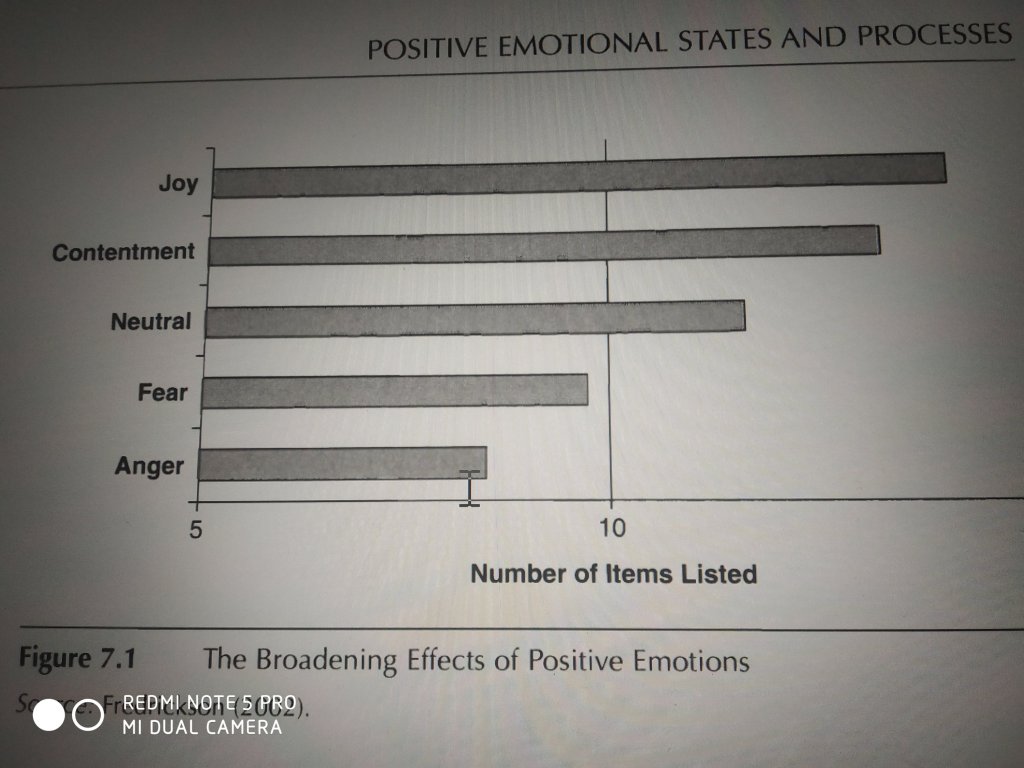
In testing her model of positive emotions, Fredrickson(2000) demonstrated that the experience of joy expands the realm of what a person feels like doing at this time; this is referred to as the broadening of an individual’s momentary thought-action repertoire. Following an emotion -eliciting film clip, research participants were asked to list everything they would like to do at that moment . Those participants who experienced joy listed significantly more desired possibilities than did the people in the neutral or negative conditions.
The purpose of this study is to show that role of positive emotions such as resilience, compassion, caring, affection, happiness, gratitude and joy all are very helpful in increasing resistance to mental illness and less susceptible to inability to withstand stressful situations. The power of emotional intelligence and positive affect is not hidden from anyone. It is a testified fact and truth.
To ensure and develop faith within the individual, they have to be reached out in the sense that the individual feels comfortable and at peace. Joy appears to open us up to many new thoughts and behaviours, whereas negative emotions dampen our ideas and perspective on happiness and love. Joy brings out the innocence in you , a second chance to rediscover your meaning and purpose of living. It makes you feel elated & thrilled to welcome new opportunities and dream doors for future prospects.
It also fills the void and the emptiness that you as a child underwent, it increases your self-worth, esteem and efficacy. When you are broken and shattered all you wish is to have someone who can hold you while you fix yourself and recover from the abrasions.
Children who have been through a complex developmental trauma repeatedly lose all hope and get blinded that there is nothing better that’s waiting for them or they can’t ever live a carefree life again.
Here are a few points that are worth applying when it comes to dealing with traumatic events with children and even grown-ups.
Enabling choice – happiness is a choice you make. We always have a choice between opposing dialects, it depends on us which path to choose. The choice will help you demarcate between what’s best for you and what is not. Making a choice to create a balance will help you in the long term well being.
Learned optimism – Optimistic people often see struggles as a part of uncomfortable growth, they do not get overwhelmed so easily by harsh realities of life, instead, they acknowledge that in spite of all the fears and adverse circumstances we face, one can and should get back up at any point of time in their life. We Can still find enough reasons to take care of ourselves and others.
Hope is the best medicine – This is one thing which we never stop doing. We hope for a better world and better us. Hope ingrains faith, faith inculcates trust, trust precedes change, change brings the purpose of life, Purpose puts up with overall wellness of mankind. Hope never dies, it breatheswithin each human being. If you can hope to regain the strength & courage, you can be the happiest person despite all the hardships.
Increasing autonomy – Now this will only happen if we try to increase self-confidence and competency, autonomy should first come from the mind and then it will be acted upon as a consequence of behaviour. A child should never be made to feel inadequate and inferior to others, or even the opposite – superior and egocentric. The right privilege and attitude are the most effective to build autonomy. They should be made to realize their own potential and how valuable they are. Often such negative, intolerant and uncompromising situations rupturemindset of the individual and they are left feeling clueless of their capabilities, either they bend towards narcissism, emotional coldness, avoidant, insensitive personalities or they delve into hyper-vigilant & neurotic mode self-sabotaging thoughts, feelings of incompetency, worthlessness & self – victim dispositions. So it is all the more crucial to help them recognize their true potentials and thereby allowing them to think and act independently.
To conclude, we all must know that no journey is the same, we all have dark pasts that can pull us down, but we must remember we are healers and this is the ultimate objective we shall abide by. Thank you & regards @ Paridhi Talwar
Human beings are social animals and we are evolutionary predisposed to be in the company of others . Human beings have biological & primitive need to belong to others our social needs ,need to affiliate with others. What better way to understand it than the fact that we are born out of another individual .
Relationships are central key to our survival . Social psychologists Roy Baumeister & Mark Leary (1995) illustrate the power of social attachments . For people everywhere ( no matter their sexual orientation), actual & hoped for close relationships can dominate thinking and emotions . Finding a supportive person in whom we can confide , we feel accepted and prized. It provides a feeling of nurture and warmth.
When relationships with partners ,family and friends are healthy , self esteem – a Barometer of our relationships – rides high. People are extremely desperate and ache for their own people and places , longing for love and acceptance relishes our well being .
Falling in love ,we feel irresistible joy and it is irreplaceable , we thrive towards it .
“I get by with a little help from my friends” – John Lennon & Paul McCartney, (1967 )
Our lifelong interdependence on one another puts relationships at the core of our existence .
However when you are deprived of this core need ,you can imagine it’s chronic long term effect . When our need to belong is thwarted , it is intensified . People exhibit heightened activity in a brain cortex area that also is activated in response to physical pain . It is an unsettling pain which can be filled only with support .
When you are rejected, neglected,given cold shoulder,octracised , excluded and shunned , ghosted , emotionally abused etc you are much more likely to be high on neuroticism , anxious , depressed , paranoid and agrressive . It impacts our social functioning , it leads to failure of interpersonal relationships.
Our irrational , persistent and intense fears and anxious states of mind can sabotage our need form healthy relationships . Fear is a silent killer ,it destroys our perception of love and to form healthy and happy interpersonal interactions with our significant others or with anyone for that matter .
Anxiety can work in curious ways and it impacts different relationships, all relations struggle sometimes when anxiety and intense fears and unpleasant emotions are at play. Fears can be of various kinds such as :-
Fear of abandonment
Fear of intimacy
Fear of commitment
Fear of being perfect
Anxiety can be manifested in different ways such as :-
Difficulty setting boundaries
Emotional Independence
Emotional coldness
Inability to be vulnerable
Social anxiety
Faulty attachment patterns
Fears and anxiety are detrimental to an emotional expression which in turn affects our functional relationships with others. The quality of a relationship is hampered and decreased followed by the touch of fear in boundaries of love. Either there is the suppression of fears and emotions OR excessive emotional responses any which way – both are inappropriate for a healthy relationship.
Clinical analyses have proven the association between prolonged periods of anxiety and fearful stimulus with impaired functioning of interpersonal relationships. Any form of anxiety have exhibited poorer relationship quality, interpersonal skills deficit, habitual maladaptive ways of relating to others, increasingly pessimistic and distress intensifying appraisals and diminished relationship satisfaction.
What can be done for healthier interpersonal relationships? How to efficiently manage our fears and forms of anxietythat interfere with the quality connections?
So there prevail assorted therapeutic techniques to strengthen the interpersonal bonds, let’s look at these :-
EMOTIONAL REGULATION – First off, recognizing your own emotional requirements before you understand others emotions. Try to regulate intrapersonal subjective affective states and organize them accordingly. If you are not able to manage your feelings & thoughts, it is more likely that emotional signals about relationships are misconstrued.
In order to be emotionally available for someone else and more agile to improve connections with your significant others, you have to have reflective regulation of emotion for oneself too.
LOOK OUT FOR TRIGGERS –
This is a salient factor in determining whether fears and anxious states are worsening your social ties or not. If you can be aware of your stress triggers, it will eventually help the individual to cope with it in a better manner and thus boosting connections with others too that were becoming a bottleneck initially due to underlying unstable psychological states.
CULTIVATING EMPATHETIC APPROACH – not only having an empathetic attitude towards your loved ones and others but also towards yourself. Empathy is important because it is okay to be flawed and know your frailties and it’s more than okay to let your close ones know that too because that’s how any healthy relationship is planted and sustained. Tenderness and affection is a top-notch virtue to break through the fearful walls which are not uplifting you and your associated equations.
STRENGTHENINGSOCIAL SUPPORT – close relationships predict better health undoubtedly. There have been extensive investigations of people across several years and have reached a common conclusion: health risks are greater among more anxious, fearful, lonely people, people who experience more distress, sleep less well and are depressed.
Compared with those who have few social ties, those who have close relationships with friends, kin or other close-knit community are less likely and susceptible to mental ailment and live happier lives.
Friendship is a sovereign antidote against all calamities. – Seneca, 5B.C-A.D65
FACILITATING INTERNAL FRAME OF REFERENCE – Internal frame of reference here means to perceive through the lens of the individual’s point of view of the world. If we try to comprehend another person’s situation from their perception and microscopic opinion maybe we can help them in a better way. It is very important and it is difficult to do the perspective-taking especially when your internal frame of reference is inconsistent with theirs. But this is a salient effort one needs to put together to create a healthier psychological state and well-being of the individual. You can only help others when you are capable of helping your self first & that’s 100% valid. You need to be consciously aware of what bothers you and try to seek help if it is something you can’t handle all by yourself when you try to change your head space with deliberate effort and will power, it brings about higher self-efficacy and that leads to the favourable and desired impact on your relationships.
CATHARTIC INTERACTION – What do we mean by this is “talk it/out”, “vent out” your feelings, apprehensions, whatever bothers you. Communication is the king, you need to attempt to express your concerns to someone you can confide in, feel comfortable with and be able to open up. Cry it out, it’s okay, but let your people realize what exactly you are going through and this is how it is impacting them and their surrounding social connections. Sometimes what we fear the most is what actually is best for us had we not worried. It seems difficult to do but it works wonders, having your loved one by your side to ensure that you are going to get the help you require and you will be heard which will eventually make you even closer to your dear ones. Catharsis releases even your innermost, hidden and suppressed fears, worries beliefs and feelings/sentiments. In turn, it rather bolsters the bond and attachment you share with your loved ones. It is an effective strategy and it has a very very positive outcome on your wellness.
To conclude, these forenamed approaches have shown exceptionally amazing results. So one must try these steps to discern the concerns they are going through. Never be hesitant to seek professional help, it’s always a wise decision to take your mental health as a prerogative. Your relationships are what shape you, influence you, build you up, help you grow and achieve. Relationships make you feel secure and instills seeds of trustworthiness and happiness. Your struggles seem a bit smoother when you have a robust support system with you.
Always try to be prosocial, it harms nobody and boosts your overall health. Thank you & regards @Paridhi Talwar
The occurence of depression is like a common cold today. It is the first leading mental illness to become a major global public health crisis .
The ancient Greek physician Hippocrates described it as syndrome of ‘melancholia’ ,he characterized it as “fears and despondencies ,if they last a long time “. The term depression itself was derived from the Latin verb *deprimere*, “to pressdown”.
Clinical vignette
Let’s understand it with a case study .
A 30 year old married woman suffers from chronic low mood and lack of enjoyment of life .She is highly dependent on her husband for practical and emotional support, although she frequently flies into rages at him ,feeling that he is cold and uncaring.she has had a series of secretarial jobs which she begins enthusiastically,but soon comes to feel that her employers are highly critical & belittling,whereupon she resigns. Her friendships are limited to people with whom she can have very special, exclusive relationships. She deals poorly with change or loss ,which frequently trigger episodes of acute dysfunction.When a friend is not sufficiently available to her , she feels betrayed and worthless,her mood plummets ,she becomes lethargic ,her eating binges and is unable to work or pursue her usual routine for up to weeks at a time.
Now it’s imperative to make a note here that depression is different on every individual ,the symptomatic picture is unique to each his own .
The above stated case is an inside look of how depression feels like , it feels like a downward spiral .
Often people with depression have signs and symptoms of :- According to Diagnostic statistical manual of mental disorders (DSM – V/5)
Persistent sad mood most of the day ,every day ( feelings of emptiness, appearing tearful)
Markedly diminished interest or pleasure in all or almost all activities ,most days , every day.
Significant weight loss when not dieting or weight gain , decrease or increase in appetite nearly every day .
Insomnia or hypersomnia nearly every day
Psychomotor agitation or retardation( feelings of restlessness or being slowed down) nearly every day.
Fatigue or loss of energy nearly every day.
Feelings of worthlessness, hopelessness, inappropriate guilt nearly every day .
Diminished ability to think or concentrate, or indecisiveness nearly every day.
Recurrent thoughts of death , suicidal ideations ,or suicide attempts .
Symptoms cause clinically significant distress or impairment in social , occupational or other important areas of functioning.
Well , having mentioned this , every illness has a cure & a wonderful news is Depression is absolutely treatable. The vicious loop can be broken .After all every dark night ends and sun rises again followed by a brighter light !!
We most definitely can rediscover our happiness path . Depression is not a choice but staying stuck in it is a choice .
Although there is no one size fits all kind of formula to find your own path of healing and recovery however there are 4 predominant ways one can apply according to their respective healing journeys . A note I would like to bring forth is PLEASE DON’T NEGLECT WHAT YOUR MIND AND BODY IS TRYING TO SIGNALYOU ,MENTAL HEALTH PROFESSIONAL IS THE POINT PERSON TO SEEK HELP FROM . A SUBSTANTIAL THERAPEUTIC RELATIONSHIP ACTS AS AN INDISPENSABLETOOL FOR THE WELL BEING OF A CLIENT .
KNOW-HOW OF YOUR CONDITION ~
First and foremost step to any concerning health issue is to be aware about your problem .Educate yourself about what’s happening to you and how you can deal with it ,take professional help understand your version in a better way . That’s the basic step to proceed on the road of rediscovering your strength and happiness.
QUALITY SELF CARE ~
I don’t think there is anything on this planet that could be moreessential and valuable than this point . Individuals brawling their battle of depression feel almost paralyzed when it comes to quality self care and love . The focus should be upon the individual in his/her entirety.
You have to go gentle on yourself despite feeling harsh and beating yourself up for reasons that are beyond your understanding .
It’s absolutely okay to handle your self with extra care ,to be willing to be empathetic to yourself, acknowledge that you are a gift to this world and your presence matters & extremely valuable .
A client centred therapy is a must and effective strategy to employ especially for clients going through depression. Client and his/her problems become the world for them and this strategy if used skillfully can pull them out of their cocoon they are entrapped in .
POWER OF COMPANION CORNER ~ let’s cry together!
Having a social support is like putting a smile on your face ,now you see ,it’s that necessary and beautiful at the same time . A sound interpersonal relationship keeps you connected with your self and the world . Social isolation is your worst enemy and individuals with depression are engulfed into the web of loneliness, emptiness, shallowness .They feel as if nobody cares how they feel which isn’t the absolute truth. It’s their mind nudging them with foggy sight which is why they assume that it’s futile to talk to anyone. There have been many researches which have clearly shown that having someone to talk to and share your experiences with has a remarkably effective outcome during the treatment of depression .It is a cathartic experience for the client .That sense of feeling safe and comfortable without any apprehensions curbs the pain you are going through . Having a non – judgemental, genuine empathetic & reflective listening attitude towards the client goes a long way in recreating their happiness. Making the person feel that you are actively going to be there for them no matter what is so so so important to break through strong walls of isolation they have built around themselves.
PLACEBO EFFECT ~ SCIENCE OF INSTILLING FAITH
If a client and therapist are both firmly convinced that eating oatmeal will cure the Client’s symptoms ,it is likely that relief will be forthcoming as long as the proper rituals have been organized around the taking of the cereal ,the client maintains faith in its efficacy . If a consequence of the conviction of being helped the patient dispels the tension and anxiety sufficiently to restore oneself a sense of control , he or she will possibly return to habitual routines and sooner or later optimal level of functioning .
Instilling hope and faith that client is in safe hands and is eventually going to feel better then the mere thought of seeking help and trusting the therapist will be a relief and that would become a base for healing process because their hope belief is shattered & unfortunately the client aggravates it more by indulging into self perpetuating cycle . Placing a garden of hope that they have a choice to feel better than yesterday on repeat will give them enough push to atleast start acknowledging the fact that there is a choice and hope to make almost always . The expectation of getting treated and improving is rewarding and reinforcing in itself .
Studies have show that there is a definite correlation between conviction and cure !!.
With this I would like to conclude that if we try to follow the aforementioned key techniques to get back up , we are already half way through .
There is always enough room for happiness and improvement .
CHILDHOOD IS A BLISSFUL SERIES OF INNOCENCE AND INNOVATION !! OUR CHILDHOOD DECIDES WHO WE BECOME LATER IN LIFE KNOWINGLY & UNKNOWINGLY. IT IS A PERIOD OF OUR LIVES WHERE WE UNDERGO RAPID DEVELOPMENT AND HOLISTIC GROWTH .
THERE ARE SEVERAL PSYCHOLOGITS SUCH AS ( LAURA. E BERK, JEAN PIAGET , LEV VYGOTSKY,ALBERT BANDURA , SIGMUND FREUD, WILLIAM G.KORNENBERGER, ROBERT G.MEYER ERIK ERIKSON ,ARNOLD GESELL & URIE BRONFENBRENNER ) WHO HAVE CONTRIBUTED TO UNDERSTAND HOW CHILDHOOD DEVELOPMENT PLAYS A PARAMOUNT IMPORTANCE IN SHAPING OUR SELF CONCEPT, PERSONALITY,EMOTIONS , BEHAVIOUR AND OUR OVER ALL MENTAL HEALTH & MORE SO THE IMPACT IT IMPRINTS UPON THE PSYCHE OF THE CHILD .
SIGMUND FREUD HAS POSTULATED THAT CHILDHOOD TRAUMATIC EXPERIENCES WHEN LEFT UNRESOLVED & UNHEALED CAN HAVE A LONG LASTING CORROSIVE AND DAMAGING EFFECT ON OVERALL PERSONALITY , EMOTIONAL INTELLIGENCE ,INTRA PERSONAL AND INTERPERSONAL RELATIONSHIPS.
HENCE CHILD IS UNABLE TO DEVELOP HEALTHY COPING MECHANISMS IN ADULTHOOD AND IS MANIFESTED IN DYSFUNCTIONAL PATTERNS OF BEHAVIOUR WHICH ARE MALADAPTIVE .
SO IT IS PIVOTAL TO UNDERSTAND AND NOTE THE KEY FACTORS THAT CAN CAUSE THE CHILD AT GREATER RISK OF DEVELOPING VARIOUS MENTAL HEALTH DISORDERS .
FAMILY SYSTEMS , COMMUNICATION SYLES , PARENTING STYLES , ATTACHMENT STYLES , SOCIO ECONOMIC CONDITIONS SUCH AS POVERTY ,RURAL AREAS , LACK OF ACCESS TO RESOURCES AND FACILITIES & OR SCARCITY OF THE SAME , UNCOMFORTABLE ENVIRONMENTS ETC.
ANY FORM OF ABUSE AND VIOLENT EXPOSURE TO THE CHILD BE IT EMOTIONAL,VERBAL,SEXUAL AND PHYSICAL – IT LEADS TO TERRIFYING CONSEQUENCES FOR THE CHILD,ALSO THEY ARE AT MORE RISK OF DEVELOPING POST TRAUMATIC STRESS DISORDER SPECIFICALLY IF THE FAMILY ENVIRONMENT IS COLD,NEGLECTFUL ,BRUTAL , AUTHORITARION ETC.
NOT ONLY THIS BUT CHILDREN CAN ALSO DEVELOP EMOTIONAL AND SOCIAL PROBLEMS IF THEY ARE OVERPAMPERED,OVERPROTECTED,OR FAULTY ATTACHMENT PATTERNS.
CHILDREN’S LIMITED PERSPECTIVE AND ALSO BEING MORE DEPENDENT ON OTHER PEOPLE THAN ADULTS LEAD THEM TO USE UNREALISTIC CONCEPTS TO EXPLAIN EVENTS ,SO A DEATH OF A LOVED ONE – WOULD BE SO OVERWHELMING FOR A CHILD IF NOT GIVEN ENOUGH SUPPORT THEY MAY TAKE YEARS ANS YEARS TO OVERCOME THAT LOSS ,THEY ARE ALSO MORE PRONE TO SYMBOLIC LOSS HENCEFORTH, THEY HAVE IMMENSE PROBLEMS SUCH AS SEPARATION ANXIETY , EXTREME DISSAPOINTMENT , CRYING SPELLS , EXPERIENCES OF REJECTION , PERSISTENT AND INTENSE FEARS SO ON AND SO FORTH .
YOUNG CHILDREN ARE ESPECIALLY VULNERABLE TO PSYCHOLOGICAL PROBLEMS .THEY DO NOT HAVE AS COMPLEX AND REALISTIC VIEW OF THEM SELVES AND THEIR WORLD AS THEY WILL HAVE LATER , THEY STILL HAVEN’T DEVLELOPED A STABLE SENSE OF SELF IDENTITY AND A CLEAR UNDERSTANDING OF WHAT IS EXPECTED OF THEM .
AS A RESULT CHILDREN OFTEN HAVE MORE DIFFICULTY THAN ADULTS IN COPING WITH STRESSFUL SITUATIONS. THEIR LACK OF EXPERIENCE IN DEALING WITH ADVERSITY CAN MAKE MANAGEABLE PROBLEMS SEEM INSURMOUNTABLE.
SO IF CHILDREN ARE PROVIDED WITH CERTAIN PROTECTIVE FACTORS I.E TRYING TO INCREASE THEIR RESILIENCE AND RESOLVING THEIR INNER PSYCHOLOGICAL CONFLICTS, UNHEALED ISSUES CHANCES ARE THEY ARE MOST LIKELY TO HAVE A HEALTHY LIFESTYLE LATER .
PROVIDING CHILDREN WITH A VERY SOLID SUPPORT SYSTEM IS THE KEY FACTOR OF HEALING JOURNEY .
GIVING THEM A CONDUSIVE ENVIRONMENT ,A SAFE COMFORTABLE SPACE AND A DESIRABLE ENVIRONMENT FOR THEIR GROWTH .
FAMILY INTERVENTIONS ARE MOST IMPORTANT SUCH AS RESOLUTION OF PATHOGENIC FAMILY INTERACTIONS , INTER PARENTAL COMFLICTS ,DIVORCE OR SEPARATION ISSUES , PARENTAL SUBSTANCE ABUSE , IMPROVING COMMUNICATION PATTERNS AMONG FAMILY MEMBERS.
PROVIDING SOCIAL SKILLS, ASSERTIVENESS TRAINING & RELAXATION EXERCISES TO BUILD RESILIENCE AND CONFIDENCE.
PROVIDING EMPATHETIC & UNCONDITIONAL POSITIVE REGARD THERE BY GIVING WARM AND WELCOMING SPACE TO A CHILD .
PSYCHO EDUCATING FAMILY AND CHILD IN THE SENSE MAKING THEM AWARE WHAT ARE THEY ACTUALLY GOING THROUGH .
PROVIDING DESIRABLE AND FAVOURABLE ENVIRONMENT SUCH AS INCLUDING A PLAYFUL AND EXPERIENTIAL CREATIVE ART BASED ACTIVITIES FOR THE BETTERMENT OF THEIR GROWTH.
THESE ARE FEW KEY PROTECTIVE FACTORS WHICH ARE FOUND TO BE REMARKABLY EFFECTIVE FOR RESOLVING UNHEALED CHILDHOOD EXPERIENCES HENCEFORTH LEADING TO A HEALTHY LIFESTYLE LATER .
It has been long since psychology as a profession has conquered its own kingdom . Mental health is the emperor of today’s time. Concept of mental health has been revolutionary over the years.
However, it wasn’t like this before clearly and evidently . The stigma around this profession is deep rooted in the psyche of the mankind . More so, i believe it’s purely a result of cultural and social conditioning that this topic wasn’t talked and discussed openly in every household which provokes me to bring this discussion on the table today .
Of course there is no doubt and denial in the fact that today psychological well being and psychologists are given their due value & vital importance they should have been given even then , nevertheless , it’s never too late they say ! & i agree .
Now let’s redefine and try to understand the stigma and pre conceived notions regarding this whole construct . It’s very common that if an individual has a disease say ,viral fever , he/she will consult doctor & take medicine for the same . But When it comes to any psychological issue/ concern , the first reaction or response is lack of awareness or acknowledgment that there is an existing problem , second of all ,even if there is awareness, there is no acceptance , thirdly , even if these 2 prevail , no steps are taken further for the improvement of the condition/health. To me it seems unfair , you are doing injustice to your self . You are denying your own realty .
Why ? Why ,because as i mentioned earlier there is a deep rooted stigma attached to it , an irrational ,intense and imbibed fear of being evaluated negatively or being judged with a prejudice by other People .
I reckon, ” Fear are lies you believe with utmost conviction “. Being treated or helping yourself is compromised & being stuck becomes the priority .When people start acting out on these values with this kind of biased attitude ,the result is *societal blemish* and it is contagious as common cold.
Problem never fades away ,it is still there rather much worse and aggravated than before because of the “extreme fear of being judged and looked down upon by our society” . Every now and then Statements are thrown around in our society like ” I am not mad,I don’t need professional help”. What will people say that i am “abnormal”? or “I am fine , there’s nothing like that , i will handle myself ” and what’s even worse ” please don’t tell anyone that I am seeking therapy”.
All these statements stem from the same source – the root cause which ought to be analysed and introspected .
In my opinion – Now is the time more than ever to reflect within our selves . It is imperative to understand that mental health is equally essential as your physical health . It’s normal and absolutely okay to go and seek a professional psychotherapist if you cannot handle your psychological issues by yourself . Overall health comes first and foremost .
It’s high time we acknowledge that we break this myth and taboo surrounded around mental health services .When was the last time you took off from office or from your work schedule because you felt low or struggled with psychological distress ? I am sure probably never have you ever done that but you probably took days off endless times when you had appointment with your medical doctor ,you had infection or food poisoning etc . It’s better we start raising awareness about this matter .Prioritizing mental health should be the new normal !!!!!
To conclude , I would like to just make this point that it’s a relief to know and see finally people are opening up , taking their holistic health seriously , not ashamed of accepting that they may be suffering and it’s necessary to take professional help . Mental health is the talk of the town at present which definitely is a breath of fresh air for our community . Hoping for a better tomorrow !!:)
 Site Title